
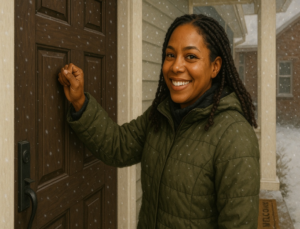
Why Did We Stop Knocking on Each Other’s Doors?
A call to return to presence, people, and belonging for the health of it!
Remember when the front door was our social network? I do. As a kid, I used to call our home “Grand Central Station” — people constantly coming and going. A simple knock meant laughter, a warm cup of tea, and connection.
But life has changed. We’re busy, overstimulated, and trying to keep pace with an ever-evolving digital world. Yet our need for genuine, heart-to-heart interaction hasn’t changed. It remains essential for our health, our happiness, and our sense of being truly alive.
Today we can barely get people to look up from their screens long enough to leave their homes and knock on a door. And when they do, that friendly knock is now monitored by a doorbell camera. The courage it takes to show up unannounced is recorded, reviewed, and often ignored. We see exactly who’s there and still choose not to answer.
As a teenager, I loved the song Let ’Em in by Paul McCartney & Wings. I would belt out the lyrics over and over: “Someone’s knockin’ at the door, somebody’s ringin’ the bell… do me a favor, open the door and let ’em in.” Back then, the song was just simply a catchy, repetitive fun tune with a groovy beat. But today, living in a technologically driven world, those lyrics feel like an anthem we all desperately need to hear. We’ve slowly lost the art of welcoming others into our lives. We need to intentionally open our homes, our hearts, and give of our time, and presence to one another.
Screens offer convenience; relationships require presence. Presence cannot be downloaded, streamed, or scrolled. Human connection is still knocking, it always is. We just need to choose to open the door. Because at the end of the day, it’s not the posts we liked or the stories we viewed that sustain us. It’s the people we sit with, talk with, laugh with and the moments we choose to experience together.
Studies around the world are documenting a steady decline in in-person socializing. At the same time, loneliness and isolation are showing up as major public health concerns. The U.S. Surgeon General recently compared the health risks of chronic loneliness to smoking up to fifteen cigarettes a day. That’s how essential real human connection is to our well-being. The World Health Organization echoes this, linking isolation to increased risks of heart disease, anxiety, depression, cognitive decline, and early mortality. In other words: connection isn’t optional. It’s a requirement.
So, where do we go from here?
- Acknowledge the truth: Too much screen time is quietly stealing our social connections and impacting our health, whether we notice it or not.
- Knock first: Make a commitment today to reconnect with someone you care about. Choose a friend you haven’t seen face-to-face in a while, someone whose voice you miss and whose presence brings you joy.
- Answer the knock: When someone shows up at your door, welcome them in. Don’t stress about the mess. Life is messy, relationships are messy and connection happens right in the middle of it.
- Try a bold reset: Turn your screens off for a few hours. Step outside. Visit someone. Go knock and let connection lead the way.
If the pandemic taught us anything, it’s that digital connection can help us, but it can never replace us. So perhaps we are all being invited now for an opportunity to return to one another. To show up. To rekindle the spark that comes from being seen, heard, and cared for in person. Because nothing compares to knowing that someone took the time to knock, to ring the bell, to say, “I’m here and you matter.”
And with all that being said, here is one final thought, has the social function of dropping in disappeared or does it just look different? What are your thoughts?
Written by Rosita Hall — motivational speaker, author, and passionate advocate for authentic human connection. Rosita inspires communities to rise above fear, lead with courage, and show up for one another in meaningful ways.